Communication · Executive Insight Brief · 342
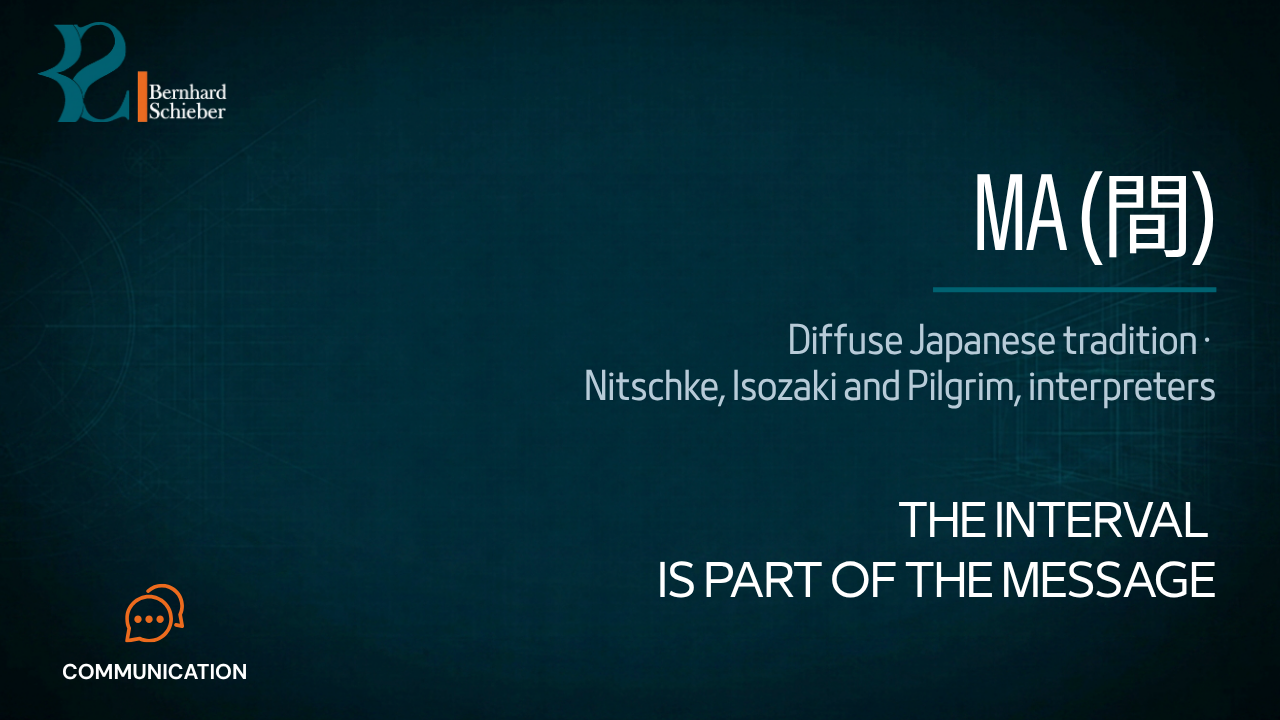
The interval is part of the message
Ma directs attention to spacing, pacing, silence, and transition as active relations whose meaning depends on what surrounds them
Premise
Communication audits usually inventory messages, channels, frequency, and comprehension. Ma adds something those inventories can miss: the interval between events. A pause can invite response, create emphasis, preserve distance, mark a threshold, or generate pressure. Its significance comes from sequence and relationship rather than from empty time itself.
For executives, the practical shift is from asking only what was said to asking how the transition was structured. The interval between a question and an answer, an announcement and discussion, or an escalation and response can determine whether another person has a usable entry point. Ma is therefore most valuable as a lens on boundaries and pacing, not as a prescription to communicate more slowly.
What the model is: Ma (間) in Knowledge →
Continue in the series
- The essential model
- Why this matters
- Risks and limits
- Executive takeaway
- Key questions
- Selected sources
The full brief is in its volume, with the other works of the series.
Need the full brief now? Request it under NDA →
New works are announced in The Debrief. Subscribe →
- FamilyModel
- CategoryConcepts & Constructs
- DomainConversation & Relationships
What these mean
Editorial orientation · Family
Model
In this series, Model names the editorial family primarily used to understand and explain communication: theories, frameworks, effects, traditions, principles and other conceptual resources. It is an umbrella for a route into the field, not a claim that every included object is a predictive model.
Editorial orientation · Category
Concepts & Constructs
Delimits an entity, property, relation or condition relevant to understanding communication. Its principal contribution is to clarify what something means, which features constitute it, and how to recognize or distinguish it.
- KnowledgeMa (間)
- Related briefThe Interaction Order: Redesign How Authority Enters the Room